Although TAO sentiment is low, deflation, high staking, and growing demand indicate huge potential; the author is strongly bullish and buys daily.
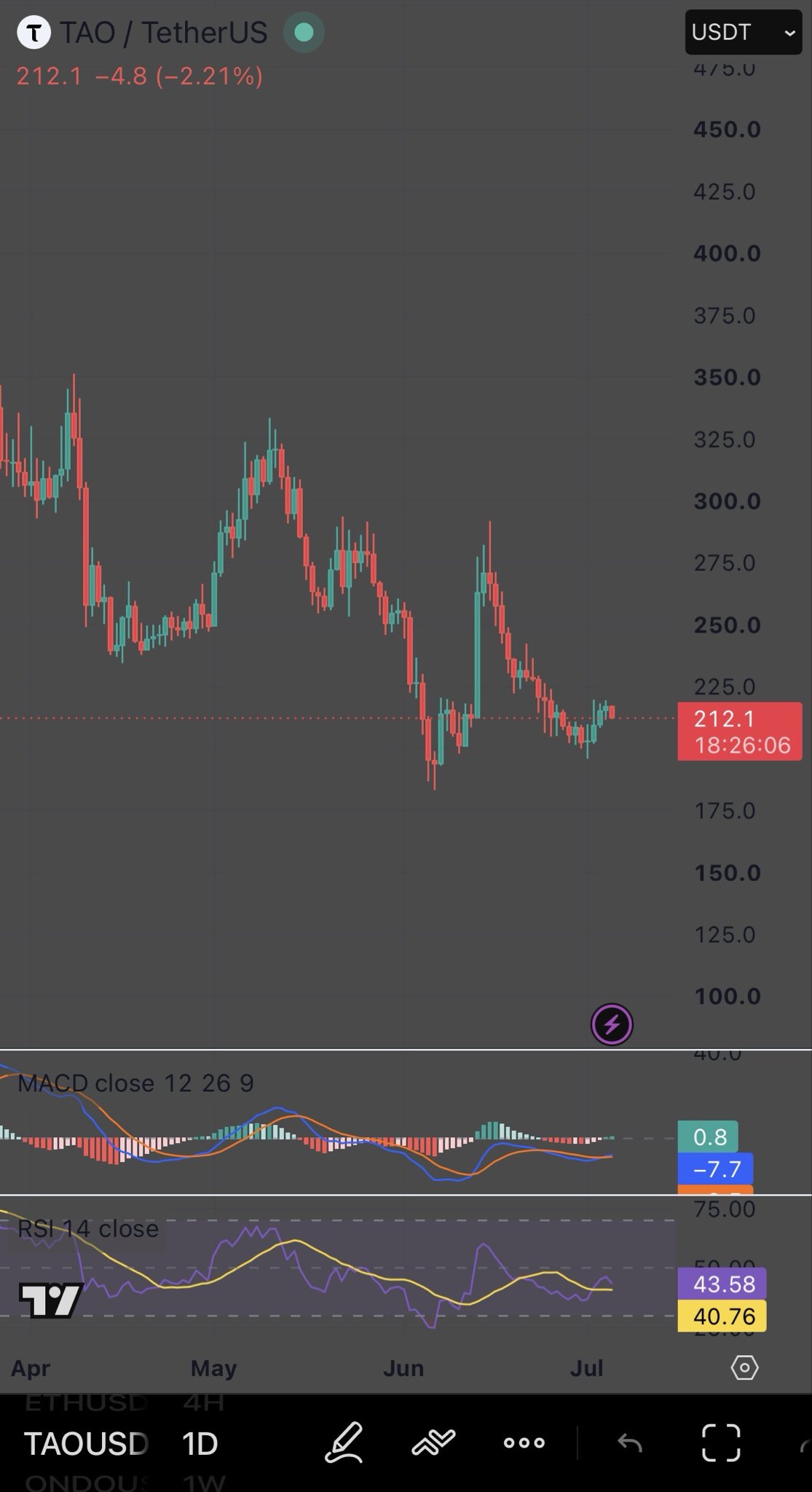
$TAO holders sentiment is on the floor. Gonna do what many don't like to do, at the bottom, look at the actual data. Because the structure being built under the price is unlike anything else I've seen in crypto, and I can prove it with the numbers.
First, tbh, yes, there is sell pressure. TaoRevenue shows roughly 65,352 $TAO of inflow and burn against 286,917 $TAO of outflow over 30 days.
Miners and validators sell emissions to cover real costs, GPUs, power, payroll. That is the toll of building actual infrastructure instead of vaporware. Most coverage stops there. That is a mistake.
Now the other side, and it is stacking:
• 46 of 128 subnets are at FULL BURN 🔥 right now, burning 100% of miner emissions. Average burn across the network sits at 55%. Emissions that never hit the market
• 44 of 126 subnets have cleared the 10 percent conviction gate, with 229.8k $TAO, roughly $48.8M, voluntarily locked on 90-day half-life terms. That is capital choosing to be illiquid
• 66% of circulating supply, 7.35M $TAO, is staked
• Total exchange balance: about 322k $TAO. Under 3 percent of circulating supply sitting on exchanges for a $2.4B asset
And then there is the part many don't consider, the Double Halving!
$TAO's first halving hit December 2025, cutting core network inflation to exactly 0.5 TAO per block 3,600 $TAO daily.
But Wait, why do dashboards show daily emissions at roughly 6,667 $TAO?
Because of Bittensor's brilliant new Emissions Refactor (Spec 421). The core token inflation is strictly capped at 3,600 $TAO, but dashboards track Gross Activity.
The remaining 3,000+ $TAO isn't new supply diluting you, it is recycled registration fees being fed back into the ecosystem.
Whats Even better: under the new price-based EMA model, these recycled rewards are stripped away from weak subnets and heavily concentrated into the most productive ones. It's a hyper-efficient loop.
Meanwhile the biggest subnet alpha tokens, Compute Horde, Targon, Chutes, are all crossing 50% issuance right now, meaning their own halvings will cut alpha emissions 50% as well.
Sell pressure from emissions is a melting ice cube on both layers of the stack simultaneously.
So the equation over time is a simple one.
Emissions, the supply side, shrink on a fixed schedule, halving after halving, toward the 21M hard cap.
Demand, the other side, is tied to real usage: every paid request burns alpha, revenue subnets like Chutes and Targon route actual cash flow, and tools like TaoRevenue by @TaoPortal , @IntoTAO , and @subnetradarcom now let anyone audit inflow, burn, conviction, and dev activity per subnet in real time.
Even deregistration risk is becoming measurable as well. TAOFlute tracks the liquidation haircut.
Basically:
If a subnet gets deregistered, what would holders gain or lose?
Some subnets have strong downside protection.
@blockmachine_io: +110%
@Apex_SN1: +95%
@Data_SN13: +79%
Weak subnets get their emissions cut, strong ones compound. The network is pruning itself in public.
Show me another asset where you can verify revenue, burn rate, locked conviction, developer commits, and supply schedule down to the block, at a $2.4B valuation, in the fastest-growing sector on earth.
You cannot.
That transparency is exactly why the pressure is visible at all, everyone else just hides it.
Low sentiment plus shrinking supply plus measurable demand plus incredible transparency.
I have seen this setup before.
It was Bitcoin, twice.
I buy $TAO daily.
Days like these are why.
$TAO / DYOR.