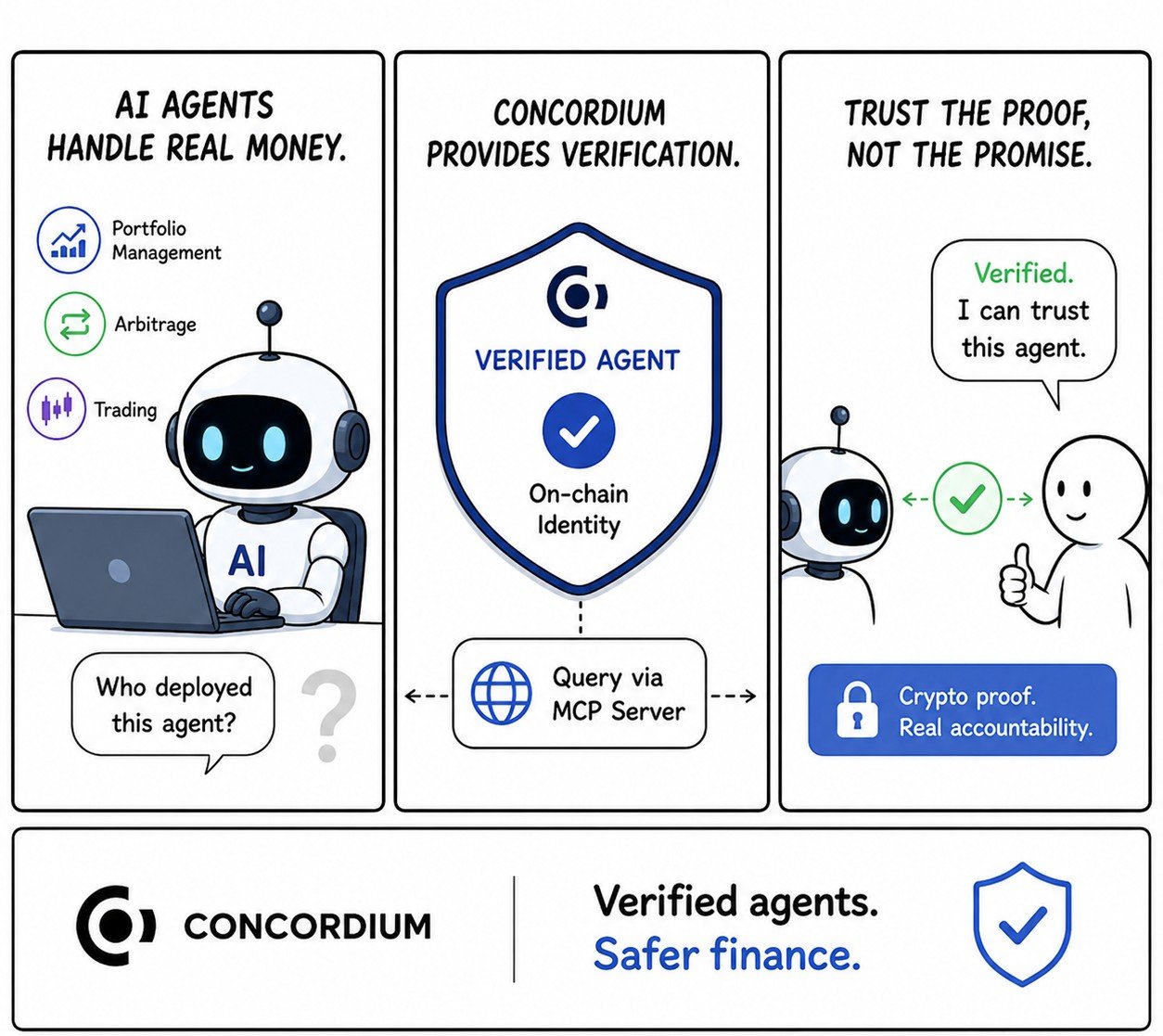
Concordium provides verifiable accountability for the AI agent economy, addressing the lack of trust and showing a positive outlook.
The Agentic Economy is moving fast, but it’s missing a critical component: accountability. It’s time we stop treating AI agents like anonymous actors and start treating them as verified participants in a global, trust-based financial system. Let’s talk about the infrastructure that makes this possible.
The promise of an autonomous future often feels like a double-edged sword. @Concordium is handing over the keys to our digital lives to AI agents, yet we’ve consistently ignored the one thing required for any real-world interaction to work: accountability.
An agent without a verifiable identity is just a black box executing code. When those agents start handling value, making decisions, or interacting with sensitive financial systems, the lack of a human "anchor" becomes a systemic failure, not a feature. We are currently building a house of cards where complexity is mistaken for progress, forgetting that in any economy, digital or otherwise trust isn't generated by algorithms alone; it’s established by the entities backing them.
This is where the transition to an agentic economy needs to pivot. We don’t need more autonomous chaos; we need verified transparency. By anchoring agent identity to a real-world, protocol-level human identity, we aren't just creating better bots; we’re creating a framework for financial and operational responsibility. It’s about moving from "who wrote this code?" to "who is standing behind this transaction?"
The infrastructure for this is already here, it’s about using zero-knowledge proofs to confirm authorization without sacrificing privacy. When an agent carries a verifiable badge of accountability, we finally bridge the gap between AI-driven efficiency and institutional-grade trust.
Explore the path to verified, accountable AI: https://t.co/LwltUiPBeB #ConcordiumAmbassador