GEODNET's 5th halving, deflationary mechanism strengthened, enterprise demand drives value growth.
$GEOD just went through its 5th halving.
And honestly, this is one of the cleaner tokenomic designs in crypto.
Why?
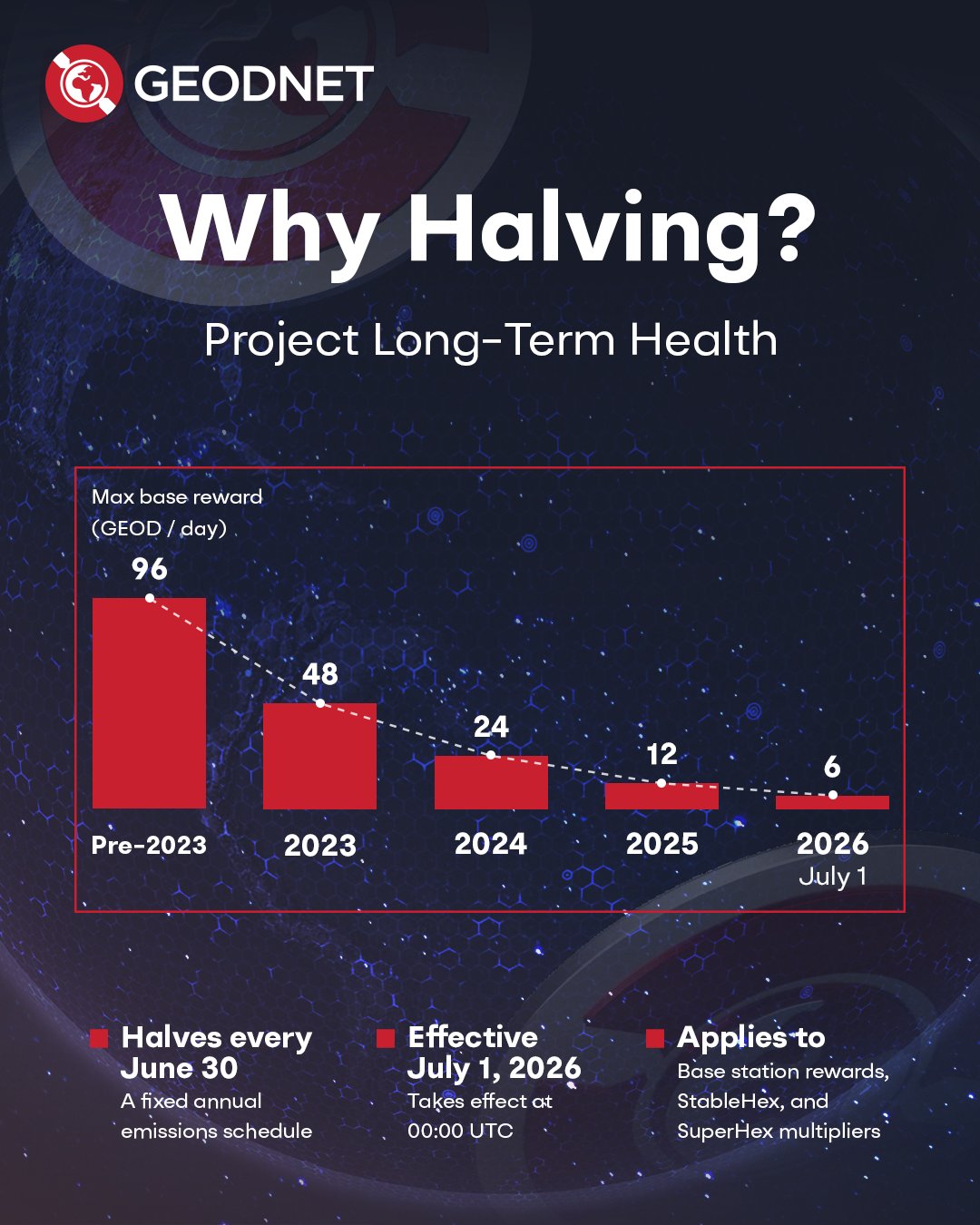
Because the emission schedule was known from day one.
No surprises. No governance vote. No token unlock drama.
Just predictable supply reduction.
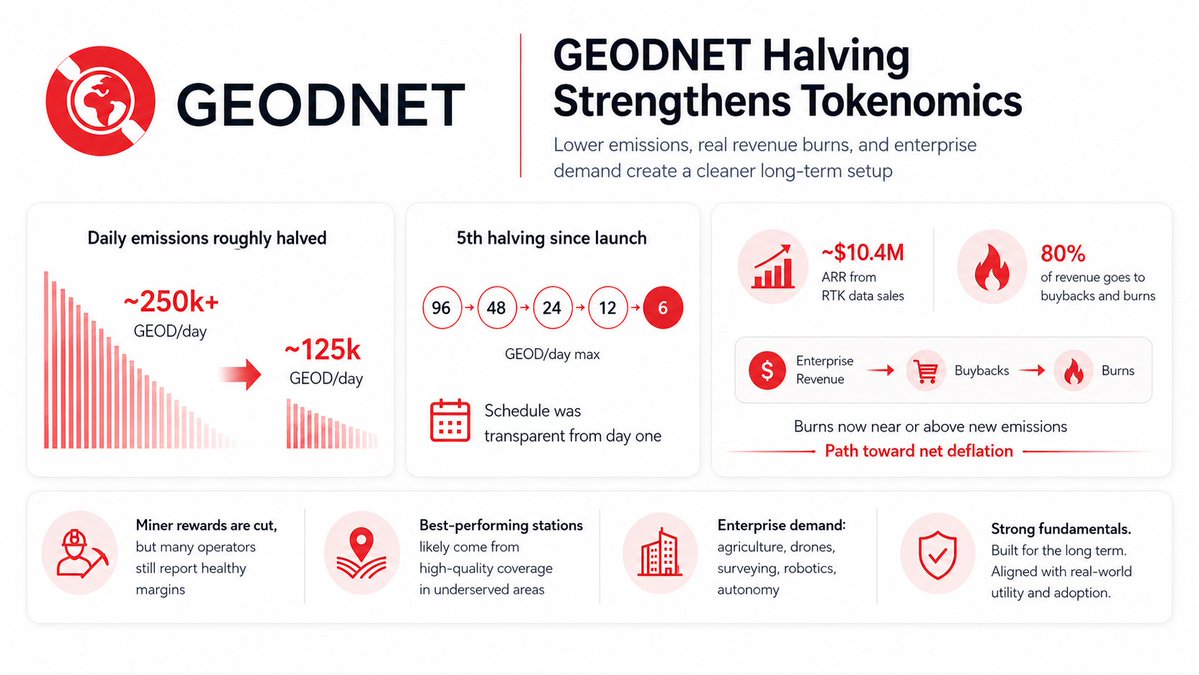
With this halving, daily emissions drop from roughly 250K+ GEOD/day to ~125K/day (exact numbers vary based on active stations and multipliers).
For context, the network has already gone through:
96 → 48 → 24 → 12 → 6 GEOD/day maximum rewards for triple-band stations.
Now combine that with the demand side.
GEODNET is currently generating roughly $10.4M ARR from selling real RTK positioning data.
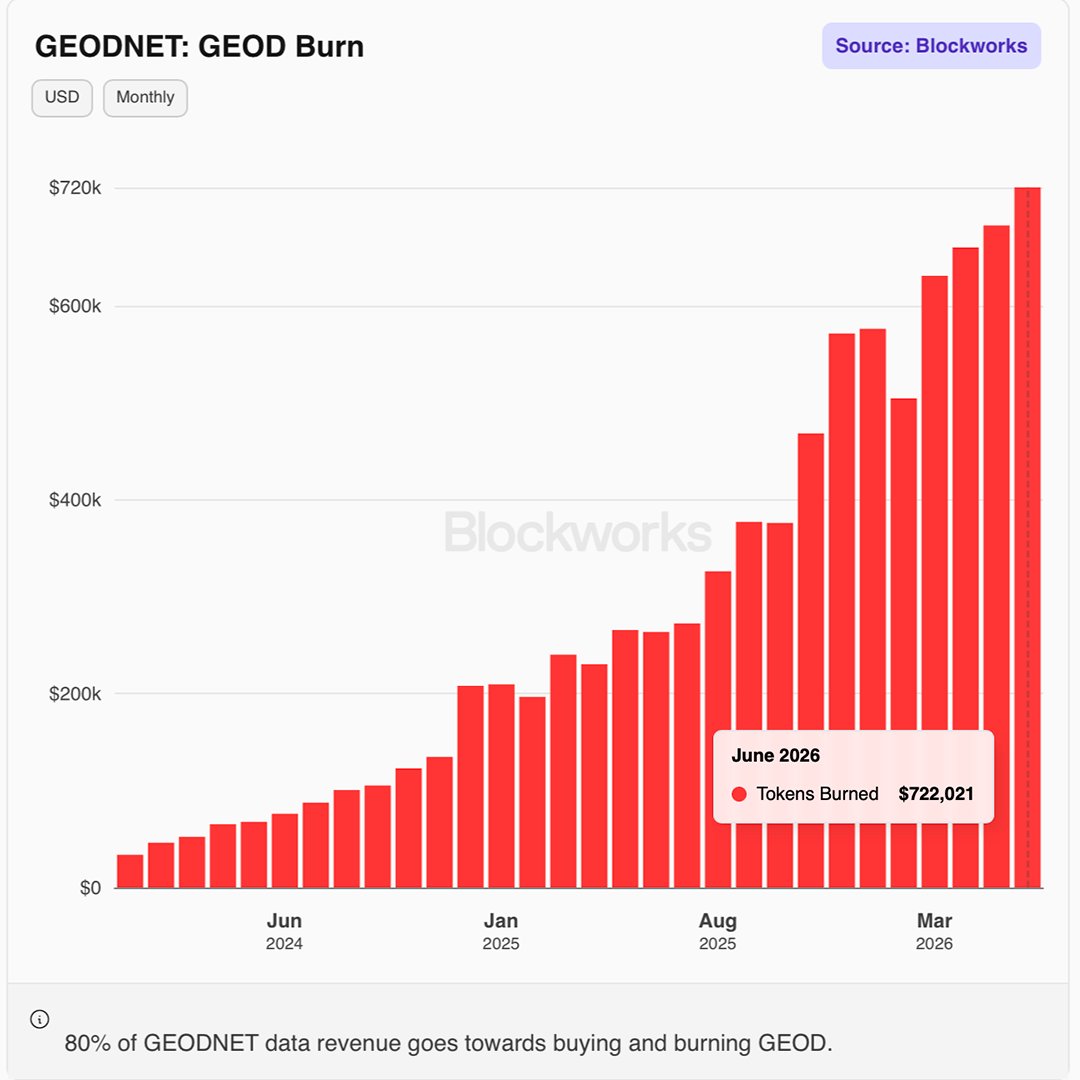
And 80% of that revenue goes directly toward buybacks and burns.
That's the important part.
Issuance just got cut in half.
Burns didn't.
In fact, if network usage keeps growing, burns could continue increasing.
Multiple analysts have already pointed out that the network appears to be approaching, or may already have entered, net deflationary territory.
That's rare.
Especially in crypto.
For miners, rewards per station are lower.
But many operators still report healthy economics, particularly for high-quality stations in valuable locations.
Going forward, location quality matters more than ever.
Stations benefiting from:
• Coverage multipliers
• SuperHex incentives
• Strong uptime
• Underserved regions
• Staking rewards
will likely outperform.
And because this halving schedule has been public for years, churn risk should remain relatively low.
GEODNET is increasingly being supported by enterprise demand.
Agriculture.
Drones.
Surveying.
Robotics.
Autonomous systems.
Real customers are paying for real infrastructure.
That creates a powerful flywheel:
More usage → More revenue → More burns.
Less issuance → Greater scarcity.
NFA. DYOR.
But the mechanics here are unusually transparent for crypto.