Get Started
Scan to Download App
iOS & Android
BitMart / Crypto / QRL

Quantum Resistant Ledger (QRL)

$
$ 0.91 (QRL/USD)
7.05%
24H

Quantum Resistant Ledger QRL Price History USD

Track the price of Quantum Resistant Ledger for today, 7 days, 30 days and 90 days
Period
Change
Change (%)
Today
$ 0.060
7.05%
7days
$ 0.020
2.30%
30days
$ 0.095
-9.45%
90days
$ 0.59
-39.40%

Own QRL Now

Buy and sell QRL easily and securely on BitMart.
Buy/Sell QRL Now
Buy/Sell {0} Now
Quantum Resistant Ledger Market Information
Last price $ 0.91
$ 0.85 24h Range $ 0.91
All time high
‎$ 3.80‎
All time low
‎$ 0.77‎
24h Change
‎7.05%‎
24h Vol
‎$ 1,075.87‎
Circulating supply
0.00 QRL
Market cap
‎$ 0‎
Max supply
105.00M QRL
Fully diluted market cap
‎$ 95.95M‎
Trade QRL

Earn

Put your idle crypto to work and earn passive income through savings, staking, and more.
Try Now
Try Now

Quantum Resistant Ledger X Insight

avatar
QRL as a quantum-resistant L1 blockchain, unique technology, the author believes the market undervalues its worth.

Quantum security is finally becoming a policy discussion in the US.

QRL has been building a quantum-resistant blockchain for the past 8 years.

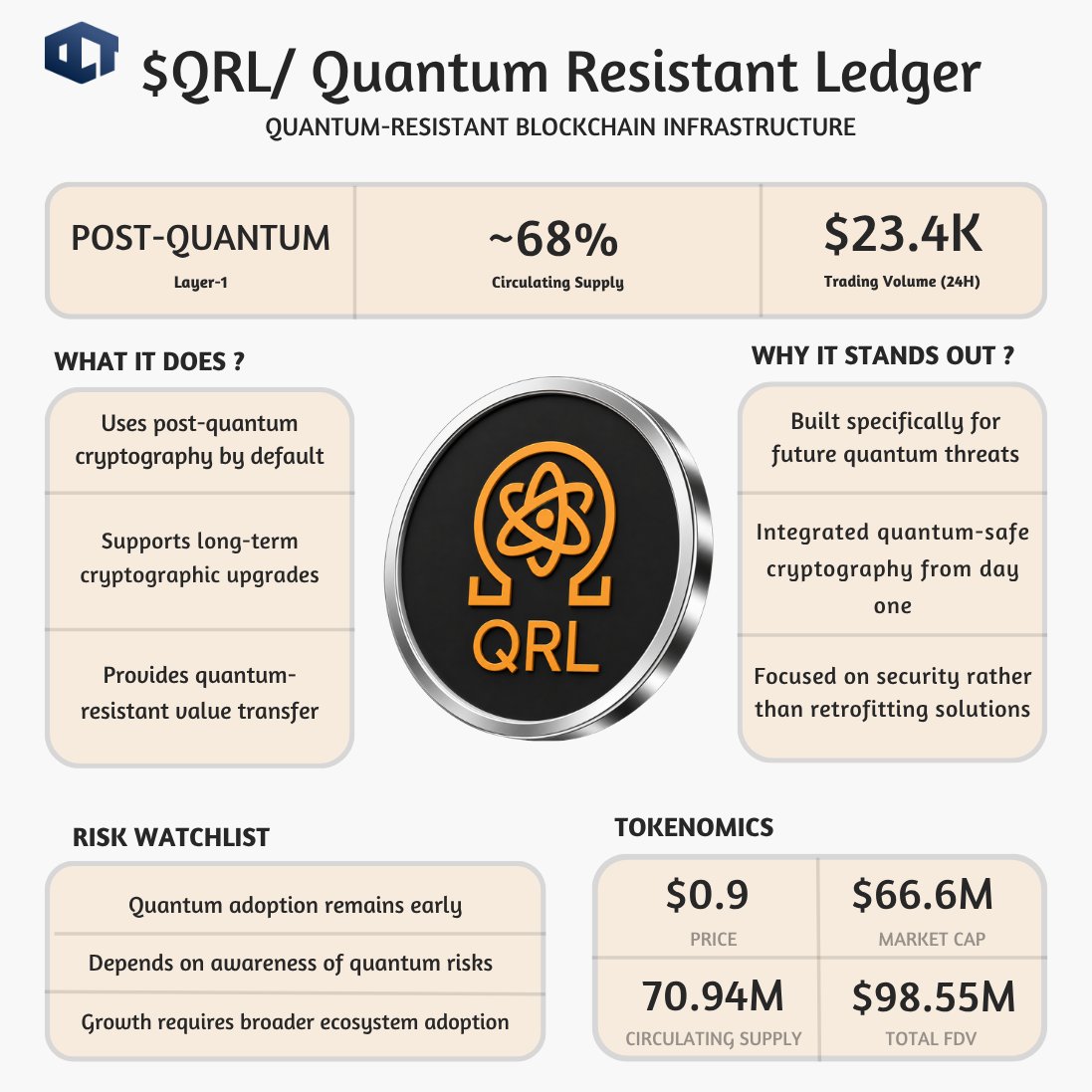
$QRL still sits near a ~$66M market cap.

Why is the market barely valuing one of crypto's oldest post-quantum networks?

QRL is a Layer 1 blockchain designed specifically to withstand future quantum-computing attacks.

Unlike most blockchains that may eventually need major cryptographic migrations, QRL integrated post-quantum cryptography directly into the protocol from day one.

The network currently uses quantum-resistant signature schemes while continuing development toward QRL 2.0 and additional NIST-standard cryptography support.

The ecosystem focuses on:

• Post-quantum security
• Quantum-resistant wallets
• Secure value transfer
• Long-term cryptographic agility
• Future Web3 integrations

The core thesis is simple.

If large-scale quantum computers eventually become practical, many existing blockchain security assumptions may need to change.

QRL was built around that problem from inception rather than attempting to retrofit solutions later.
There are still important challenges.

The biggest one is timing.

Quantum threats remain largely future-oriented, meaning adoption depends heavily on:

• Broader awareness of quantum risks
• Developer ecosystem growth
• Increased demand for quantum-safe infrastructure
• Real-world usage beyond the security narrative

Supply is not a major concern:

• ~71M tokens currently circulate
• Maximum supply is relatively close to current issuance
• Future value depends primarily on network adoption and mining activity

At the same time:

• No major exploit history surfaced
• No public governance controversies emerged
• Development has remained consistently focused on post-quantum infrastructure for nearly a decade

Tokenomics

• Price: ~$0.93
• Market cap: ~$66.6M
• Circulating supply: 70.94M
• Total supply: 79.62M

Always take whatever you read on the internet with a pinch of salt, do your own research, NFA.
view 26
view 1
view 1.2K
2026-07-02 10:42
Trend of QRL after release
Bullish
QRL as a quantum-resistant L1 blockchain, unique technology, the author believes the market undervalues its worth.
avatar
QRL is being exploited by LLM, its security is questioned.

Yep

avatar

You’re telling me that the quantum-proof coin meant to replace Bitcoin was exploited by an LLM? Can’t make this up.

view 1
view 0
view 31
2026-06-05 16:27
Trend of QRL after release
Bearish
QRL is being exploited by LLM, its security is questioned.
avatar
QRL, ALGO, SOL and other chains need to watch the new PQ signatures; migration remains challenging

🔔Post-Quantum Signatures: NIST's Second Wave

In August 2024, NIST finalized its first PQC standards: ML-KEM (key exchange), ML-DSA, and SLH-DSA (signatures). A third signature, Falcon (FN-DSA, FIPS 206), is still in draft.

Last week, NIST announced the nine candidates advancing to Round 3 of a parallel competition aimed at additional signature schemes, explicitly chosen to fill the gaps left by the first wave.

Each of the standardized signatures comes with sharp trade-offs. None of them is naturally suited to threshold signing, and all have signatures that are large compared to ECDSA's 64 bytes.
➡️ SLH-DSA (SPHINCS+, hash-based) The most conservative choice: its security rests only on the collision resistance of a hash function. The price is enormous signatures (7–50 KB !!!). It is the safest pick for very long-lived signatures (firmware, archival, some blockchains such as QRL).
➡️ML-DSA (Dilithium, lattice-based). Compact and fast, while elegant, is younger than hash-based assumptions. It is becoming the default for TLS, PKI, and most non-blockchain ecosystems (~2.4 KB signatures).
➡️Falcon (FN-DSA, lattice-based). The smallest of the three (~666 B at NIST-I), which is why Algorand and Solana selected it. Its drawback: signing relies on floating-point arithmetic, making error-prone and side-channel-resistant/ constant-time implementations notoriously hard. Its FIPS 206 standard is still in draft.

🔍Most blockchains are leaning towards customized shorter versions of SLH-DSA.

NIST is organizing a second wave of standardization. The goal is twofold: shrink signature sizes and diversify the underlying mathematics so a single cryptanalysis breakthrough cannot break everything. The nine Round 3 finalists span five families:
🔸 Isogeny: SQIsign
🔸 Lattice: HAWK
🔸 MPC-in-the-Head: MQOM, SDitH
🔸 Multivariate: MAYO, QR-UOV, SNOVA, UOV
🔸 Symmetric-based: FAEST

Notably, no code-based scheme survived. Both Round 2 candidates were eliminated: LESS and CROSS were dropped because of 2 attacks

👉 Two candidates worth watching
⏩ SQIsign produces the smallest known post-quantum signatures by a wide margin: from 148B to 292B (depending on the level of security), with sub-130-byte public keys. That is the only PQC signature scheme today that even approaches the bandwidth profile of ECDSA, extremely attractive for blockchains, certificates, and firmware. The catch: isogeny-based cryptography is still young, signing is mathematically intricate, and side-channel hardening is an active research area.
⏩HAWK is essentially "Falcon without the floating-point." It is a lattice hash-and-sign scheme producing 555 B signatures at NIST-I (smaller than Falcon's 666 B) and can be implemented purely with integer arithmetic, a major engineering win.

NIST has said the Round 3 review will last roughly two years and that any multivariate winners are unlikely to be standardized without yet another round. Realistically, the earliest a new signature standard will land alongside ML-DSA and SLH-DSA is 2028.

The urgency to migrate has grown sharply, yet the current standards still have significant drawbacks, and this last-minute selection round, while necessary, collides head-on with the migration timeline.

view 81
view 12
view 14.7K
2026-05-18 13:37
Trend of QRL after release
Neutral
QRL, ALGO, SOL and other chains need to watch the new PQ signatures; migration remains challenging
Details

Price Prediction

When is a good time to buy QRL? Should I buy or sell QRL now?

When deciding whether it’s a good time to buy or sell Quantum Resistant Ledger (QRL), it’s important to first align with your own trading strategy and risk profile.Long-term investors and short-term traders often interpret market conditions differently, so your decision should reflect your personal approach. According to the latest QRL 4-hour technical analysis, the current trading signal is Hold. According to the latest QRL 1-day technical analysis, the current signal is Hold.
41
Hold
4-hour technical analysis of QRL
Last Update 2026-07-05 07:59:59
45
Hold
1-day technical analysis of QRL
Last Update 2026-07-06 00:00:00
beacon

Beacon Prediction

Probabilistic Price Forecast (Next 24 Hours)
i
Beacon Prediction Disclaimer
The data results displayed on this page are analyzed based on actual trading data (OHLCV) of the selected trading pair along with corresponding technical indicators.
This prediction is an experimental technical product and is provided for reference purposes only. It does not constitute investment advice. Unexpected real-world events may significantly impact market behavior. Traders should make decisions with caution.
About Quantum Resistant Ledger
Quantum Resistant Ledger (QRL) is a cryptocurrency launched in 2016. Users are able to generate QRL through the process of mining. Quantum Resistant Ledger has a current supply of 79,620,322.93146174 with 0 in circulation. The last known price of Quantum Resistant Ledger is 0.88514948 USD and is down -1.83 over the last 24 hours. It is currently trading on 10 active market(s) with $72,188.85 traded over the last 24 hours. More information can be found at https://theqrl.org/.
Read More
Buy QRL
Trade QRL