🧵Why are Velo and Lightnet quietly building in Indonesia?
The answer starts with shrimp 🦐
Here’s why,
most people still see @veloprotocol as just another crypto project
But the bigger story isn’t crypto.
It’s financial infrastructure.
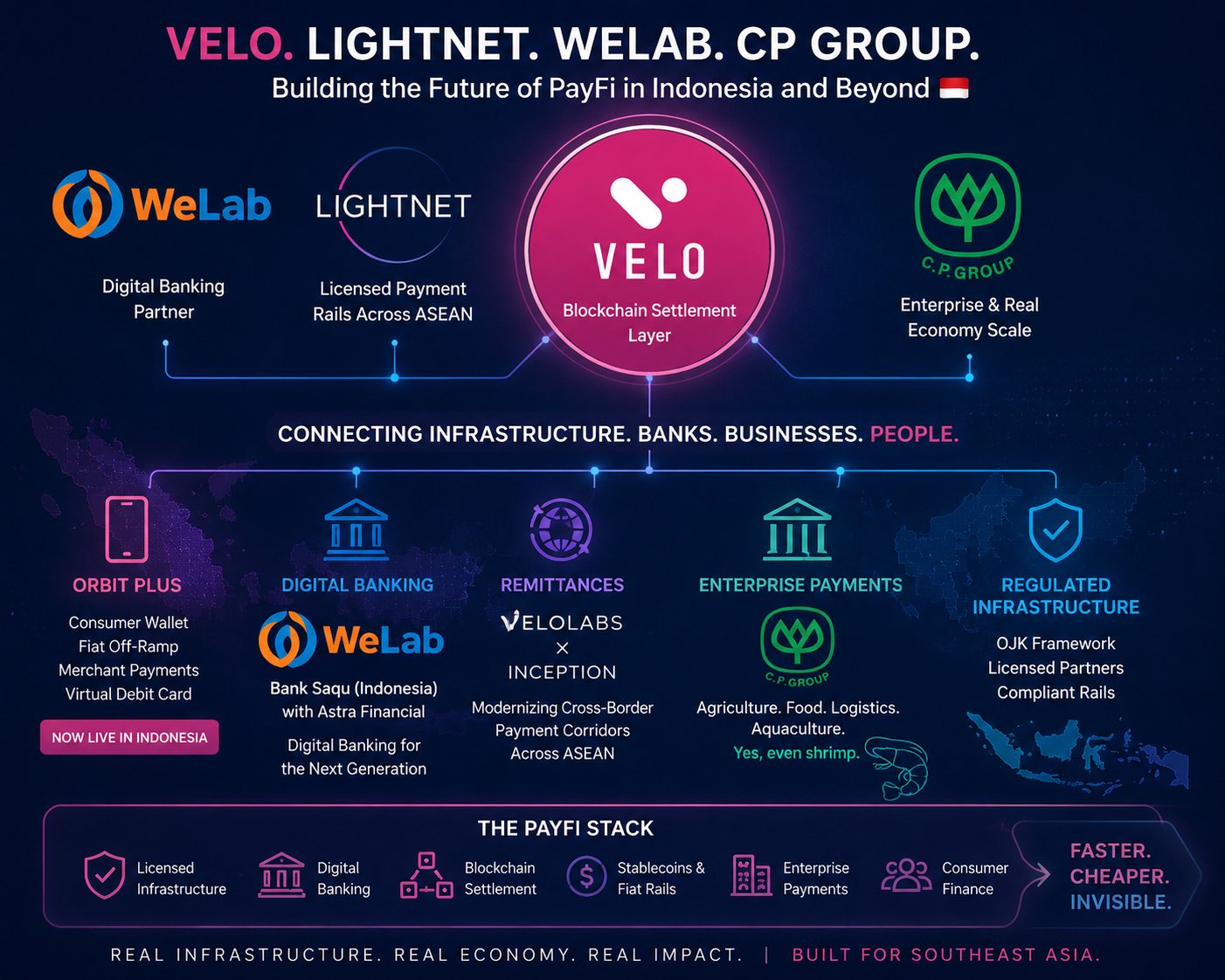
For years, @lightnetgroup has quietly built licensed payment rails across ASEAN
Velo provides the blockchain settlement layer, enabling faster, cheaper and compliant cross-border payments behind the scenes.
Now look at Indonesia.
Orbit Plus has launched its first fiat off-ramp beta, allowing users to convert digital assets into Indonesian Rupiah and settle directly to local bank accounts.
Indonesia is one of ASEAN’s busiest remittance corridors
For PayFi, this isn’t just another market.
It’s one of the most important proving grounds.
Indonesia is also strengthening its regulatory framework.
Moving crypto oversight to the OJK reflects the country’s push to integrate digital assets into its financial system.
That trend is becoming increasingly visible
BTSE recently launched BTSE Indonesia through a regulated joint venture, expanding licensed IDR fiat rails.
This isn’t about BTSE partnering with Velo.
It’s about Indonesia rapidly becoming a hub for regulated digital financial infrastructure.
But the story doesn’t stop with regulation.
It also reaches into banking.
Lightnet has built strategic relationships across Southeast Asia’s financial ecosystem, including its partnership with WeLab.
WeLab entered Indonesia in 2018 through a joint venture with Astra Financial, acquired Bank Jasa Jakarta in 2022 and transformed it into Bank Saqu in 2023.
Bank Saqu is now one of Indonesia’s fastest-growing digital banks.
It shows how digital banking and next-generation payment infrastructure are converging across ASEAN.
Another key piece is remittances.
Velo Labs partnered with Inception to modernize cross-border payment corridors across Southeast Asia.
Indonesia sits at the center of one of the region’s busiest remittance networks.
For millions of migrant workers, faster settlement means lower costs and quicker access to money.
Then there’s the enterprise layer.
The CP Group, one of Southeast Asia’s largest conglomerates, has operated across Indonesia for decades.
Its businesses span agriculture, food production, logistics and aquaculture.
Yes… even shrimp. 🦐
That may sound amusing.
But this is exactly where blockchain becomes real economic infrastructure.
These industries move enormous value across borders every day.
To be clear, there is no public evidence that CP Indonesia currently settles its operations through Lightnet or the Velo Protocol.
However, Chatchaval Jiaravanon, co-founder of Lightnet, comes from the family behind @CPGroup_Live.
That doesn’t prove adoption.
But it illustrates the scale Lightnet was designed to support.
Now add Orbit Plus, bringing together consumer wallets, fiat off-ramps, merchant payments and planned virtual debit cards.
This is far more than another wallet launch.
It looks like another layer of ASEAN’s emerging PayFi stack.
Licensed payments.
Digital banking.
Blockchain settlement.
Stablecoins.
Fiat rails.
Enterprise payments.
All moving in the same direction.
The question isn’t whether someone pays with Bitcoin.
It’s whether blockchain settlement becomes invisible.
Customers pay digitally.
Merchants receive local fiat.
Banks remain part of the system.
The blockchain simply becomes infrastructure.
Indonesia may be the first major domino.
Because when regulated financial infrastructure, banking networks, enterprise ecosystems, remittance corridors and consumer payment applications begin converging in the same market…
it’s worth paying attention.
This isn’t just Velo.
It’s Southeast Asia quietly building the next generation of financial infrastructure.
And sometimes…
the future of finance doesn’t begin on Wall Street.
Sometimes it starts with migrant workers, digital banks, food supply chains…
and Shrimps 🦐