 USDC (USDC)
- 84Índice de Sentimento Social (SSI)-8.47% (24h)
- #36Classificação do Pulso de Mercado (MPR)-6
- 95Menção Social 24H+106.52% (24h)
- 44%Índice Bullish dos KOLs (24h)71 KOLs Ativos
- ResumoCoinbase-Spiko EU tie boosts USDC use; OUSD consortium launch pressures Circle, spurs stock fall amid big minting.
- Sinais Bullish
- EU UCITS USDC access
- Institutional fund USDC use
- Large USDC minting on Solana
- DeFi vaults adopt USDC
- AI agent payments use USDC
- Sinais Bearish
- OUSD consortium launch
- Circle stock drop 14‑17%
- USDC price slight dip
- EU MiCA payment caps
- Supply dilution from minting
Índice de Sentimento Social (SSI)
- Dados Gerais84SSI
- Tendência SSI (7D)Preço (7D)Distribuição de SentimentosExtremamente Bullish (9%)Altista (35%)Neutro (17%)Baixista (16%)Extremamente Bearish (23%)Insights de SSIUSDC social heat is moderately low (84.37/100, -8.5%), with a 35% drop in positive sentiment being the main cause, affected by EU access and Circle stock decline.
Classificação do Pulso de Mercado (MPR)
- Insight dos AlertasUSDC warning rank fell to #36 (↓6), social anomaly level remains at 100, KOL attention shift ↑104% indicating OUSD consortium and large-scale minting trigger attention shift.
Posts no X
 Jeremy Allaire - jerallaire.arc Founder Influencer B181.00K @jerallaire
We’ve had lots of questions from our investor community looking for thoughts on OUSD, and so I thought I’d share my direct views here for anyone. Stablecoin networks are platform and network effect businesses that are established over a long period of time, tend towards winner-take-most market structures, and resemble other internet platform utility markets. There are several layers that drive this. First, stablecoin networks effectively act as public protocols and software layers on the internet and their network strength is a matter of the number and range of applications and services that integrate to the network. Every time a developer or service provider integrates to the network, it brings more network effects. This attracts more developers and adds more utility and more network effects. This then drives demand for the digital currency itself, which then reinforces these network effects through liquidity network effects. We have realized this at a massive scale with the USDC network today — thousands upon thousands of services integrate with our network, which in turn provides immense utility not just to each application, but to users as a whole who benefit massively from the reach and interoperability that exists. This drives user and developer preference further. We’ve invested in building that ecosystem over nearly a decade, and now it’s accelerating as mainstream institutions come onto the network, connecting their customers and users. We add to that utility by building software stacks that further expand and strengthen the network — protocols like CCTP and Gateway, which promote interoperability, safety and liquidity around the world. This expands the target surface area for app builders and developers, making it easy for them to tap into the liquidity and network effects that already exist. We are now seeing that stack get pulled into all kinds of chains, permissioned L2s, networks being built by governments, and so much more. The second layer is that of liquidity network effects. This is fundamental. Liquidity begets liquidity. For a stablecoin to achieve scale and utility, it needs to be highly liquid, both on a primary basis (e.g., through all the major financial market centers in the world, with world class direct banking liquidity) and on a secondary basis both by being available and tradeable for retail and institutional clients in every geography and against every fiat instrument in the world. People who want to access and move value need to be able to easily get in and out of that digital currency. Here, we’ve invested nearly a decade in building out that liquidity, and it is now entrenched in exchanges, DeFI venues, and with PSPs, payments firms, regional exchanges, and so many others. Establishing these liquidity network effects also involves building global regulatory infrastructure and ensuring that the stablecoin is available under various regimes around the world. Today, USDC is in the top 3 most liquid digital assets in the world, and it falls off sharply after that. BTC, USDT and USDC have extraordinary liquidity. The closest other dollar stables are like 10x smaller and that liquidity tends to be concentrated in promotional books in a single exchange, whereas USDC liquidity is dispersed widely across dozens and dozens of surfaces. Building this liquidity has been a nearly decade-long task that we continue. A third layer of network strength comes from the deep integration with the policy and regulatory environment — in many cases, years of effort to build licensing (e.g., USDC is the only large global stablecoin currently available in all of Europe or Japan), and more regimes for stablecoins are coming online, with Circle leading the way in ensuring that USDC is officially recognized, registered, licensed and accepted in the most important markets in the world. On the back of this is the work of building global banking, reserve management and treasury and liquidity management that can operate this on a nearly 24/7 basis in markets and banking systems globally. This globalization effort is a massive investment that we have made over the years. All of these investments by Circle and our global ecosystem of thousands of partners have delivered the net result of providing the world’s most trusted and available digital dollar infrastructure—a utility that any user, developer, or business can freely and easily tap into. And we do not intend to slow down. All of this compounds and shows in the numbers. In Q1 2026, according to third-party analysts (Artemis) who track stablecoin adoption, USDC handled nearly $30T in onchain transactions, representing 80% of all dollar stablecoin transactions on blockchains. USDT handled the remaining 20% of transactions. All of the combined remaining dollar stablecoins handled a total of 0% of transactions (i.e., < 0.5%). While other stablecoins may have some circulation, most of that is through promotions and incentives, the actual usage is extremely limited—because of the extremely limited liquidity and network utility that exists for these coins. But my thoughts on the competitive landscape are not just about the strength of our network—there are also considerations around any new initiative. Several perspectives and positioning have been shared about how something like OUSD improves on something like USDC. 1) Free mint and burn. The argument suggests that existing stablecoins charge burn fees, and payments firms should not need to pay these (despite the fact that the entire payment industry is built on small bps fees on various ingress and egress points on their networks). There are structural market realities built around the fact that some stablecoins impose very large redemption fees and have limited redemption facilities – the impact of this is that stablecoins with strong redemption facilities, good liquidity and no fees become the offramp for their competitor stablecoins. It may seem easy to say one will offer unlimited and free redeems, however market reality likely forces other behavior. This can be addressed – and is addressed by Circle – through contractual mechanisms vs. a blanket fee exemption. 2) Everybody wins and shares. While this sounds good in principle, the reality of the market and market opportunity is quite different. Today, Circle shares the majority of its income with its distribution partners, and we continue to lean hard into expanding those partnerships with leading companies across every sector of the market. However, we also retain significant income that allows us to invest in the massive market infrastructure that makes this such a powerful and valuable utility for the world to build on. Giving away all the income is a recipe for starving an infrastructure, systematically underinvesting and ensuring that your platform will remain limited in scope. Furthermore, Circle believes that the future stablecoin market is likely several orders of magnitude larger than it is today. We’re actively bringing partners into the USDC ecosystem through a diverse and growing set of partnership models that span our work with exchanges, custodians, payments firms, asset issuers and more. We are excited to continue to build with a “big tent mentality” where the entire ecosystem can grow value together. 3) A consortium where everybody has a voice. Perhaps I have a cynical view, but the track record of consortium products achieving scale, P/M Fit or even basic product agility is absolutely dismal, and while there are examples of financial consortia that operate utilities, they are predictably slow moving. Large groups of large companies coordinate poorly, have misaligned incentives, slow things down and rarely create the space for real durable innovation and competitiveness. They also typically, out of their own self-interest, starve the consortium itself on an operating basis. We actually tried this in the early days of USDC, and even with a very small group, ran into endless challenges and complexity. Smaller, tighter strategic collaborations and commercial partnership arrangements with product and platform builders that can drive forward independently will almost always outcompete large consortiums. But oftentimes when these get formed, everyone feels like they should put their logo on the list, kiss the ring, and make noise about openness. But typically those same firms will turn to their operating units and make the best decisions for their customers, which often means partnering with the market leader and building durable win-win partnerships. There’s also been a bunch of commentary on Circle's partnership with Coinbase and what this all means. Our stablecoin partnership with Coinbase remains as strong as ever, and I think we both see that enormous opportunity ahead to expand the USDC network. A final comment: Circle remains committed to supporting a wide range of different products and infrastructures, even when we might compete with different aspects of those partners’ products in other areas of our business. With OUSD, we work closely with many of the founding members, and we expect that those same members will remain large USDC partners and customers. At the same time, as Circle has diversified our product and platform stack, expanding across Arc, CCTP, CPN, StableFX, Agent Stack and many other areas, we continue to expand the partnerships and collaboration with many other stablecoin issuers — dozens of them — to help them launch on Arc, leverage our interoperability infrastructure, get supported in our Wallets and become settlement and FX options on CPN and StableFX. We are huge believers in growth in the stablecoin ecosystem and welcome OUSD as a new member of the community!
68 15 3.68K Ler original >Tendência de USDC após o lançamentoAltistaUSDC leads stablecoins through network effects, OUSD finds it hard to surpass. Somτum_Lnwza007 Educator Influencer S4.48K @Somtum205849
$CRCL good stuff, boss, please keep it.
 TP SQUAD D4.87K @tpsquad_th
Circle in trouble? Last night Circle's $CRCL fell more than 17% after the launch of $OUSD. $OUSD is a new Stablecoin from Open Standard, backed by a consortium of over 140 major companies. Companies that use $OUSD earn interest directly from the Reserve, unlike $USDC which depends on deals. Major companies include Visa, Mastercard, Stripe, American Express, BlackRock, Coinbase, Google. Many of these companies were previously partners with Circle. This launch could significantly affect $USDC's future growth, especially for long‑term partner Coinbase. Even though Circle provides interest from the Reserve held for Coinbase and has recently renewed the partnership, a slowdown in $USDC growth forces Circle to seek deals with other partners and pay them interest, a portion that normally accounts for more than 90% of Circle's profit, resulting in a substantial revenue loss. On the $USDC side, growth continues to decline, having hit an all‑time high of $79 billion in March 2026 before slipping to $73 billion, roughly comparable to October last year. Removal from indexes. In addition, Circle was removed from several Russell Growth indexes during this period.
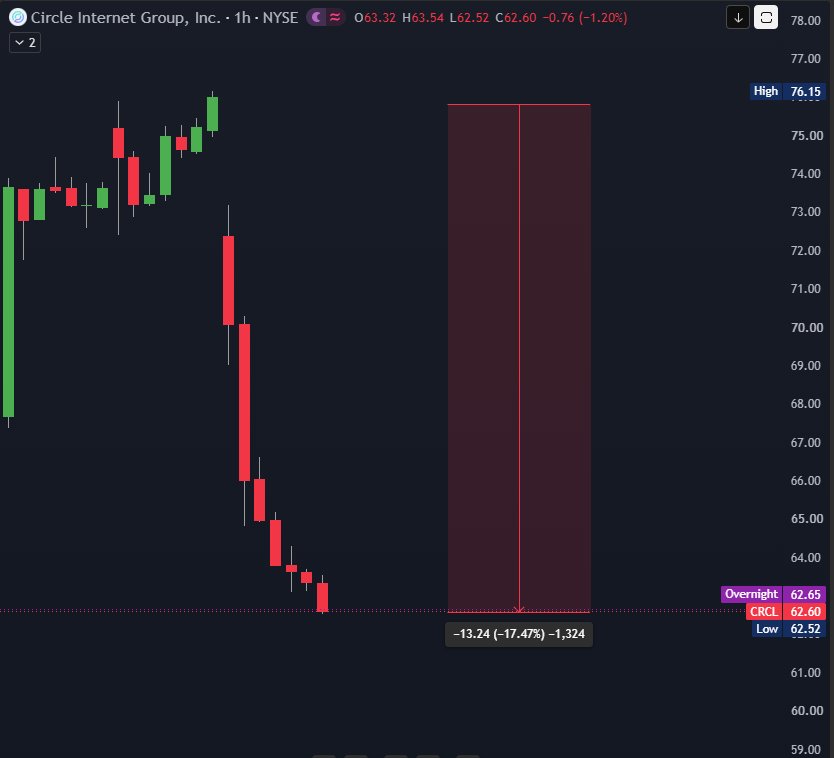 1 0 165 Ler original >Tendência de USDC após o lançamentoExtremamente BearishOUSD launch and slowing USDC growth caused Circle's stock to plummet, threatening its revenue and USDC market share.
 Onchain Lens OnChain_Analyst Media C42.42K @OnchainLens
A newly created wallet "0x93A" deposit $4M $USDC into #HyperLiquid and opened 200 $BTC long position with 20x leverage Seems like there are now 4 wallets linked to the same wallets holding 800 $BTC (20x) long position valued at $47M New Wallet: https://t.co/q48T3e6D3F Old Wallets: https://t.co/cVNPBtVC0M https://t.co/Xdg75nW8Ca https://t.co/eRIS3tzyfg
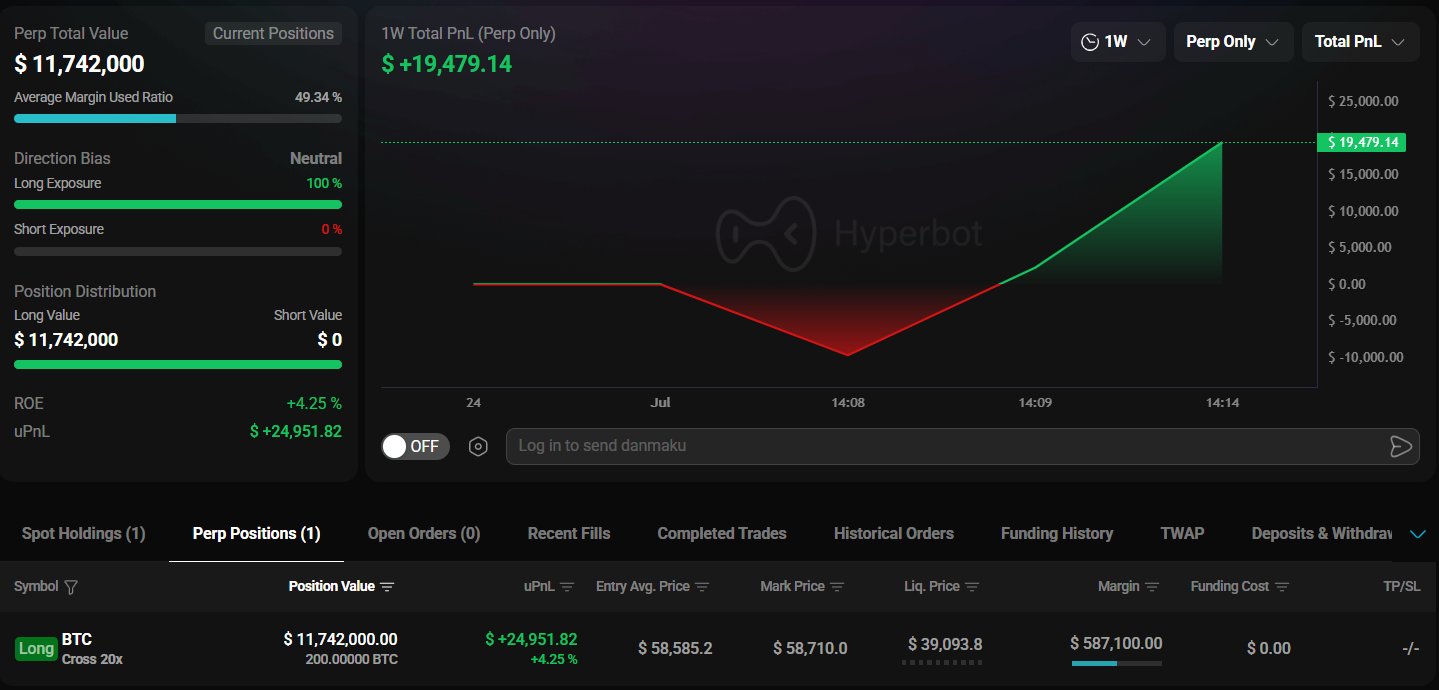
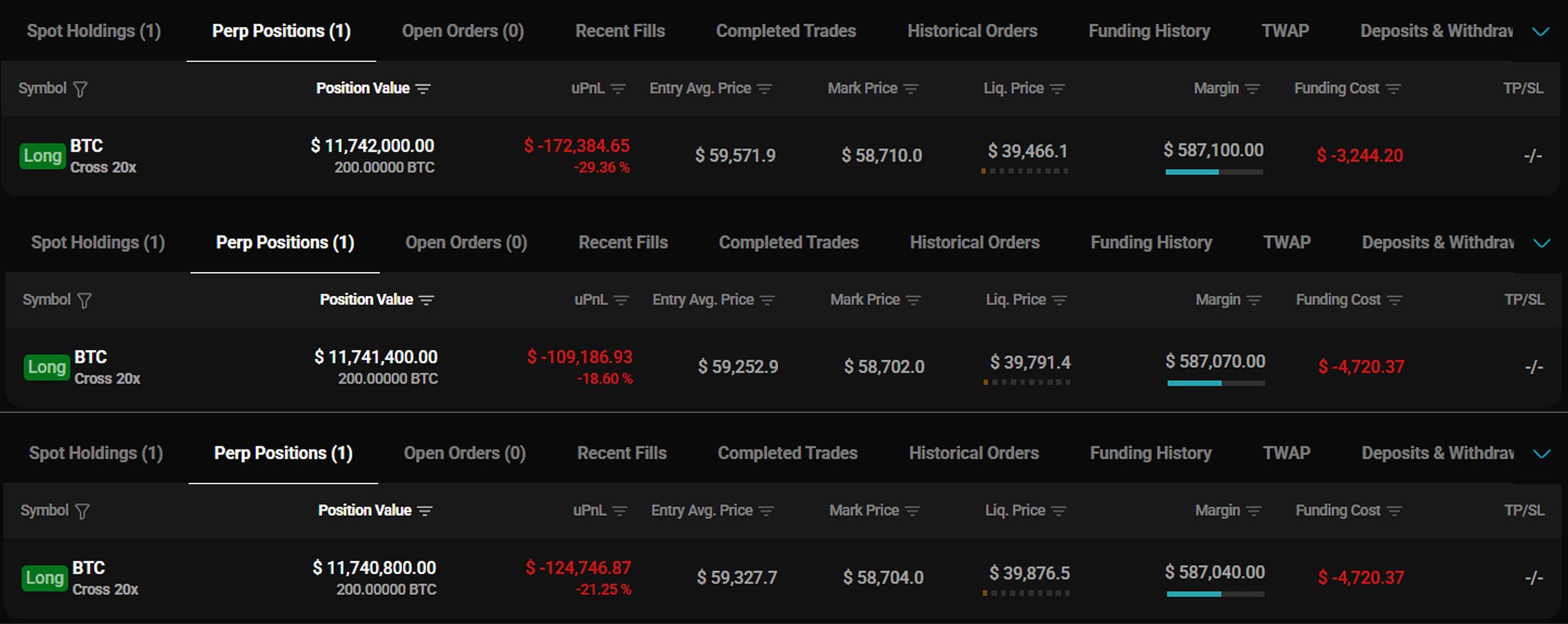 10 4 3.22K Ler original >Tendência de USDC após o lançamentoAltistaA whale opened a massive BTC long position on HyperLiquid, totaling 800 BTC with 20x leverage, worth $47 million.
 BITWU.ETH 🔆 FA_Analyst Educator D375.19K @Bitwux
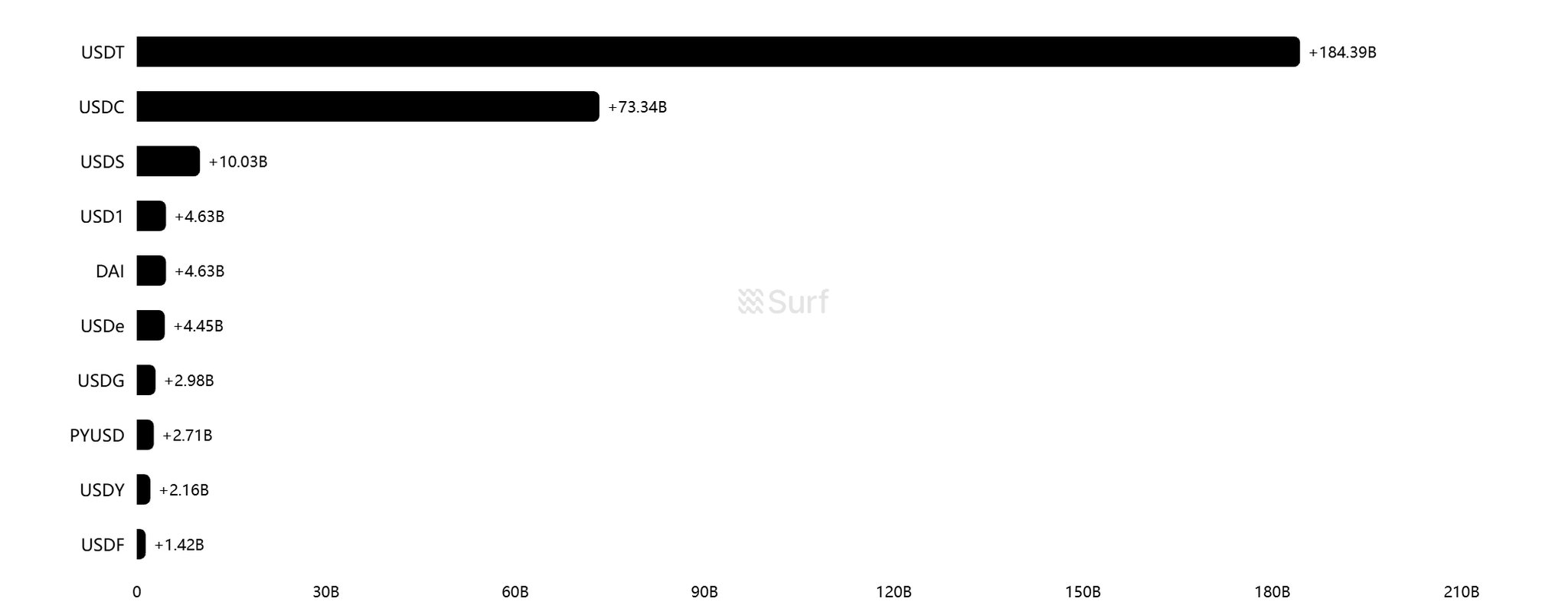
🚨We pulled up the market cap a bit; the stablecoin market remains highly concentrated, and Open USD would need to overcome a very high liquidity hurdle to truly reshape the market landscape. Let's assume that once Open USD launches— 🔺To break into the current top ten stablecoins, it would need a supply exceeding roughly $1.42B; 🔺To enter the top five, it would need to exceed roughly $4.63B; 🔺To reach the top three, it would need to exceed roughly $10.03B; 🔺To genuinely threaten $USDC's volume, it would need to approach or exceed $73.34B. This cannot be achieved merely by an announcement; it requires real enterprise settlements, exchange liquidity, DeFi collateral use cases and a fiat on‑off‑ramps closed loop. Additionally, OpenUSD's shortcomings are quite evident: The 140+ member list looks intimidating, but the larger the consortium, the slower the decision‑making—a consensus recognized; when rapid risk management, on‑chain risk, and regulatory response are needed, governance becomes more complex; Thus, the decisive players are really only Stripe, Coinbase, Visa, and BlackRock—how much real traffic they can bring over. The best comparator here is $USDG — $USDG is also a revenue‑sharing stablecoin, driven by Paxos together with Robinhood, Kraken, Galaxy and other partners. Currently $USDG has reached a market cap of about $2.98B, ranking 7th among stablecoins, proving that revenue‑sharing + consortium distribution is a viable path. But it also shows that even with a correct model, entering the mainstream stablecoin tier does not automatically replace $USDC; there remains more than an order of magnitude gap. OpenUSD's ceiling will certainly be higher than USDG's; let's wait for the data after launch: Real supply, sustainable liquidity, transparent compliant reserves, etc. Circle may need to find ways to pass on benefits later.
 BITWU.ETH 🔆 FA_Analyst Educator D375.19K @Bitwux
🧐What is Circle falling? Does its moat still exist? First, the result: I think $CRCL is oversold in the short term; if market sentiment causes further overshoot, I would consider buying a portion, However, I am not confident about holding it long term at this point; more observation may be needed. Because the fundamentals and moat have clearly undergone huge changes, as I detail below! Previously I have been researching a question: What exactly is a company's true moat? Today, the stablecoin track Open Standard announced the launch of Open USD, a new stablecoin backed by over 140 companies including Visa, Stripe, Mastercard, BlackRock, and Coinbase. Investors are assessing the competitive threat it may pose to USDC. The resulting sharp drop provides a very thought‑provoking issue about moats! 1️⃣ What exactly is $CRCL’s decline about? Open Standard officials also state that Open USD is designed as follows: Enterprises can mint/redeem at zero cost, with no human‑scale limits; partners receive the reserve asset earnings from Open USD, minus a small management fee; governance is jointly decided by the independent company Open Standard and a partners’ board. The participant list includes Visa, Stripe, Mastercard, American Express, BlackRock, BNY, Google, Shopify, Coinbase, Solana, Base, Ripple and many other payment, finance, technology and crypto‑infrastructure companies; Stripe also publicly said Open USD will become the default stablecoin choice for Stripe’s business users; This makes it clear: Open USD is not attacking USDC with technical parameters, but with a distribution mechanism. Circle’s core profit pool comes from reserve asset earnings; Open USD’s core slogan is to return more of that earnings to the partners that bring traffic. In other words, OUSD intends to share the economic benefits that were previously retained with Visa, Stripe, Shopify, Coinbase, banks, wallets, exchanges and merchant ecosystems to quickly acquire users. The “USD 1:1 + on‑chain transfer” technology of stablecoins is not the deepest moat; the real moat lies in trust, regulation, liquidity, distribution, integration, use cases and economic incentives. Now the wolves are coming, naturally people see another possibility. Therefore I think the representative point here is: A single technology is not a moat; the ability to continuously turn it into an irreplaceable product and profit for customers is the moat. I have discussed this theme many times with friends before, why Buffett…
30 23 5.32K Ler original >Tendência de USDC após o lançamentoBaixistaOpen USD threatens USDC's moat; the author is bullish on Circle's oversold condition in the short term, but cautious in the long term. icefrog.◎ 🇻🇳 Quant OnChain_Analyst C7.29K @icefrog_sol
JUST IN: On-chain shows 3x surge of $USDC moving into Solana DEX pools in last 24h. That liquidity doesn't sit it buys memecoins, then alts run. If you're not watching small-cap orderbooks on Solana, you're late ⚡️
5 4 74 Ler original >Tendência de USDC após o lançamentoAltistaUSDC flows into Solana DEX threefold, boosting memecoins and small-cap tokens, need to monitor orders. Biteye Media Educator D80.93K @BiteyeCN
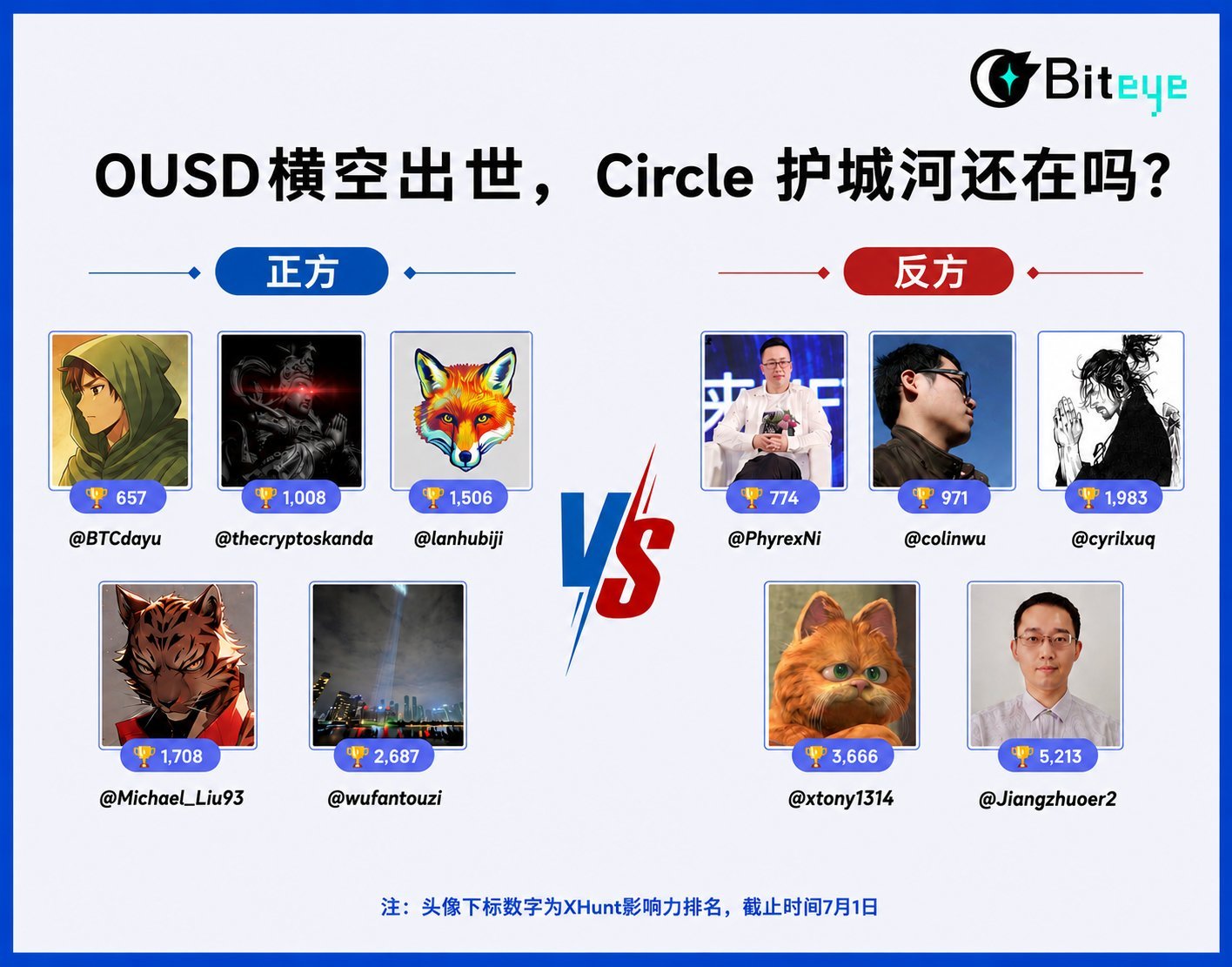
🔥 OUSD Appears Out of the Blue, Is Circle's Moat Still Intact? Visa, Stripe, Mastercard, BlackRock, Coinbase and dozens of other financial companies are pushing a new stablecoin called OUSD. As soon as the news broke, CRCL’s stock price fell sharply. If traditional finance, payment networks, and exchanges all start jointly issuing stablecoins, how much moat does USDC have left? The plunge in CRCL’s share price essentially reflects the concentration of this worry. So the question arises: Is Circle an over‑valued “interest‑rate‑spread bank”, or a stablecoin infrastructure leader that the market has unfairly killed? Take a look at the bullish‑bearish debate on Circle, with the main points from each side 👇 📈 Bullish on Circle / The stablecoin cake will get bigger First debater – DaYu @BTCdayu | XHunt rank 657 DaYu is neutral‑bullish, believing CRCL is like early Tesla, and stablecoin compliance is like an open‑source trend. The long‑term market will grow, but the process won’t be smooth. He thinks USDC remains the most important player in the compliant stablecoin track, but its moat isn’t permanently safe; in the future it will face three challenges: competition from new stablecoins, revenue‑share pressure from Coinbase, and how much market the compliant B‑side USDC can actually capture. 💡 Core judgment: CRCL is worth watching and long‑term attention, but you can’t hold it purely on faith. What truly determines valuation are the future C‑side, trading scenarios, prediction markets, etc., and which will choose USDC, USDT, or other stablecoins. Second debater – Crypto Wei Tuo @thecryptoskanda | XHunt rank 1008 Crypto Wei Tuo says: based on experience, statements from seven or ten ministries are loud but have little effect, but when a single body like the Ministry of Public Security or the Organization Department issues a document, that signals a major event. 💡 Core judgment: The more joint endorsements, the less accountability. The same applies to stablecoins as to official red‑header documents. Third debater – Blue Fox (@lanhubiji) | XHunt rank 1506 He believes OUSD will not end the stablecoin battle nor completely win the market, but it can capture a slice of the cake. Although OUSD is backed by over 140 companies, including Visa, Mastercard, BlackRock, Coinbase, Stripe, Shopify, Google, etc., it naturally has payment channels, merchant networks, bank partnerships and institutional resources. This gives it opportunities to quickly enter enterprise payments, settlements, cross‑border remittances, RWA scenarios, and so on. 💡 Core view: OUSD will not easily replace USDT/USDC. USDT still has the strongest liquidity and trading depth, and USDC is already ahead on the compliance path, with comparable transparency and institutional adoption. OUSD will pressure Circle, but it does not mean the end of USDC. Fourth debater – Simple‑minded Mike @M
 17 1 3.28K Ler original >Tendência de USDC após o lançamentoNeutroThe emergence of OUSD has sparked discussion about USDC's moat, and the market is divided on Circle's outlook.
 ☯️MR_DYOR|🦺🦇🇳🇬 Educator FA_Analyst B3.17K @MR_DY0R_Of_Web3
 Lucky Esemuede D3.45K @Lucky_of_Web3
Recap of June for me: > Created 6 articles (the highest in my content creation journey) > Got accepted into @SoulsLabs creator program > Made 30 USDC from participating in a simple task > Participated in 3 contest, lost one with two pending I will do better in July 🙏
21 14 219 Ler original >Tendência de USDC após o lançamentoAltistaAuthor earned 30 USDC in June, feeling confident for July Mars_DeFi Researcher Educator B26.17K @Mars_DeFi
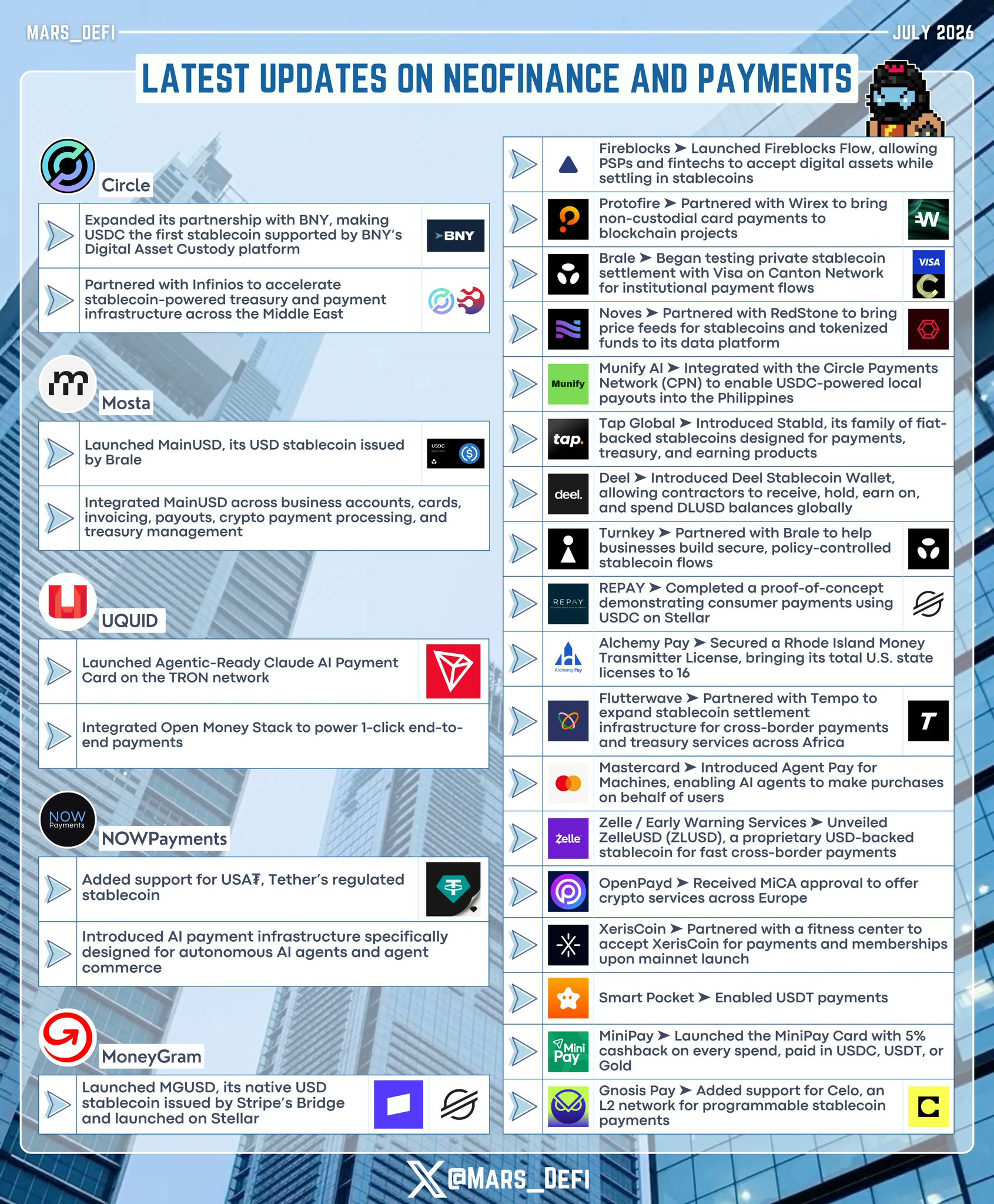
June saw another wave of innovation across neobanking and payment infrastructure. Financial institutions, stablecoin issuers, and fintech platforms rolled out new products, expanded payment rails, and strengthened the infrastructure connecting TradFi with onchain economies. Here’s a roundup of the biggest neofinance and payments updates in June. — ● @circle • Expanded its partnership with @BNYglobal, making USDC the first stablecoin supported by BNY’s Digital Asset Custody platform • Partnered with Infinios to accelerate stablecoin-powered treasury and payment infrastructure across the Middle East ● Mosta • Launched MainUSD, its USD stablecoin issued by Brale • Integrated MainUSD across business accounts, cards, invoicing, payouts, crypto payment processing, and treasury management ● @uquidcard • Launched Agentic-Ready Claude AI Payment Card on the @trondao • Integrated Open Money Stack to power 1-click end-to-end payments ● @NOWPayments_io • Added support for USA₮, @tether’s regulated stablecoin • Introduced AI payment infrastructure specifically designed for autonomous AI agents and agent commerce ● @MoneyGram • Launched MGUSD, its native USD stablecoin issued by @stripe’s Bridge and launched on @Stellar_Org ● @FireblocksHQ • Launched Fireblocks Flow, allowing PSPs and fintechs to accept digital assets while settling in stablecoins ● @protofire • Partnered with @wirexapp to bring non-custodial card payments to blockchain projects ● @Brale_xyz • Began testing private stablecoin settlement with @Visa on @CantonNetwork for institutional payment flows ● @Noves_fi • Partnered with @Redstone_DeFi to bring price feeds for stablecoins and tokenized funds to its data platform ● @Munifyai • Integrated with the Circle Payments Network (CPN) to enable USDC-powered local payouts into the Philippines ● @TapGlobalPlc • Introduced Stabld, its family of fiat‑backed stablecoins designed for payments, treasury, and earning products ● @deel • Introduced Deel stablecoin wallet, allowing contractors to receive, hold, earn on, and spend DLUSD balances globally ● @turnkeyhq • Partnered with @brale_xyz to help businesses build secure, policy‑controlled stablecoin flows ● REPAY • Completed a proof‑of‑concept demonstrating consumer payments using USDC on @Stellar_Org ● @AlchemyPay • Secured a Rhode Island Money Transmitter License, bringing its total U.S. state licenses to 16 ● @theflutterwave • Partnered with @tempo to expand stablecoin settlement infrastructure for cross‑border payments and treasury services across Africa ● @Mastercard • Introduced Agent Pay for Machines, an infrastructure that lets AI agents make purchases on behalf of users ● @Zelle / Early Warning Services • Unveiled ZelleUSD (ZLUSD), a proprietary USD‑backed stablecoin to power fast cross‑border payments ● @OpenPayd • Got MiCA approval to offer crypto services across Europe ● @xeriscoin • Partnered with a fitness center to accept XerisCoin for payments and memberships upon mainnet launch ● @smapocke • USDT payments went live on Smart Pocket ● @minipay • MiniPay card went live, offering 5% cashback on every spend, paid in USDC, USDT, or Gold ● @gnosispay • Added support for @Celo, an L2 network for programmable stablecoin payments — June made it clear that stablecoins are evolving beyond crypto assets into core financial infrastructure. As stablecoins, AI agents, and programmable payments become increasingly intertwined, the gap between TradFi and onchain payments continues to narrow, and this momentum is likely to continue throughout H2.
 65 67 1.59K Ler original >Tendência de USDC após o lançamentoExtremamente BullishJune saw stablecoin and new financial payment infrastructure innovation active, driving integration of traditional finance and on‑chain economies.
 Alex🌖⃤ Founder Dev B8.52K @axldefi
When we started in 2022 we started from zero No audience, no big names backing, just community Hard work, failures, successess, bear market, bull market, lots of competition and a lot of blood and sweat We get spotlighted by @circle Everything is achievable, if you crazy enough to believe in it Now, we have 5 products live and another one coming We do what we know the best, building despite all challenges One day, it will pay off, and the pack shall feast Wolfies to millions!
18 5 646 Ler original >Tendência de USDC após o lançamentoExtremamente BullishThe project started from zero in 2022, has launched 5 products, and its outlook looks promising. The Crypto Times Media Influencer B10.72K @CryptoTimes_io
JUST IN: @circle has minted another 1 billion $USDC on @solana. Bringing its total $USDC issuance on Solana in 2026 to 64.25 billion. https://t.co/ywsENhP9kT
 1 0 414 Ler original >Tendência de USDC após o lançamentoNeutroCircle minted an additional 1 billion USDC on the Solana chain, bringing total issuance to 64.25 billion.


